After a Couple Cocktails, Don't Attempt the Stairs
It was a crisp autumn evening in 1977 when Halston invited Bill and me to dinner at his townhouse on East 63rd Street. By then, we were regulars—familiar with the rhythm of his evenings, the vodka-forward cocktails, the casually curated guest list. But that night? That night had its own kind of magic.
Halston’s home, a Paul Rudolph architectural marvel, was sleek, austere, and quietly theatrical. Multi-levels connected by floating stairs with no railings—dangerous after two drinks, iconic always. Everything was gray: the walls, the carpeting, the deep, sculptural furniture covered in limousine cloth. Even Lindo, his beloved Weimaraner, matched the palette.
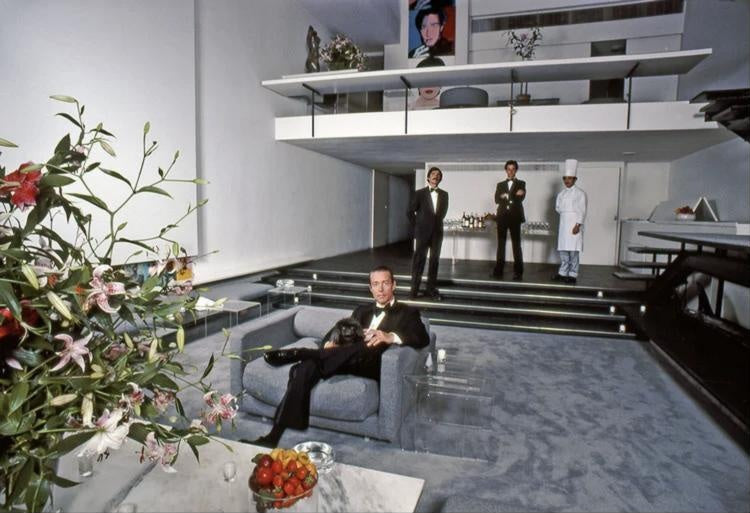
Bamboo rose from the sunken terrarium like an indoor forest, while phalaenopsis orchids seemed to bloom from every surface. Votive candles flickered low. It wasn’t just a space—it was a mise en scène.
We were greeted at the door by Mohammed Sumaya, Halston’s devoted houseman, who moved with the ease of someone who’d seen everything and would never tell. In the living room, we air-kissed D.D. Ryan, Halston’s in-house oracle of taste and martini master, who was already mid-pour. The first round was served. The mood was effortless.
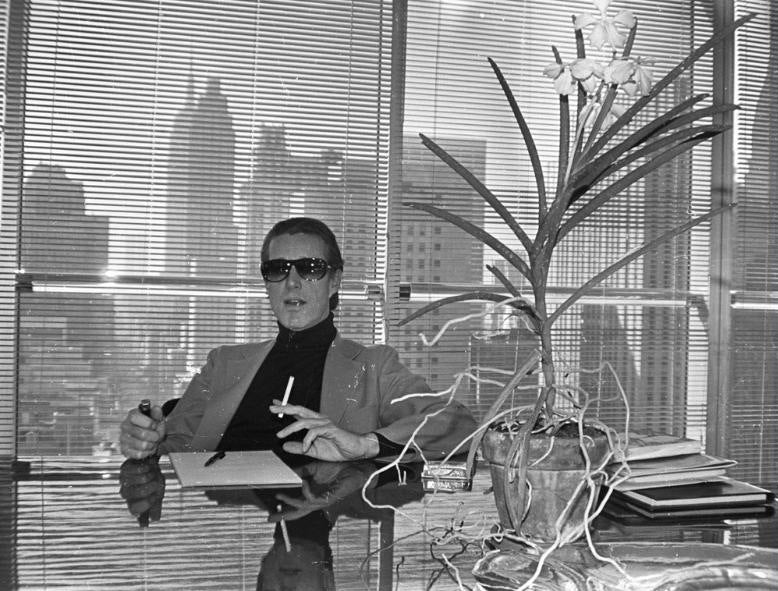
Halston had a way of making his home feel like both a stage and a sanctuary. He’d often perch with a legal pad, sketching freely between sips, the music low and steady. There was no separation between life and work—it all flowed together.
That night, conversation meandered through fashion and gossip and what Viola, Halston’s cook, had in the oven. The drinks flowed, and no one was in a hurry. Then, without fanfare, Mohammed swept in with dinner: a spread of grilled steak, baked potatoes, toast points with caviar-slicked sour cream, and roasted asparagus.
Halston looked up, slightly amused, and said, “Here’s dinner. Just grab a plate and we’ll sit around the coffee table.”
And so we did.
We were halfway through our second glass when we got word: Liza was coming. And not just Liza—she was bringing company. She was filming New York, New York at the time, so we were braced for fabulous. But when the door opened and in swept Liza Minnelli—followed by Martin Scorsese, Robert De Niro, Harvey Keitel, and Christopher Walken—the room shifted.
It was one of those moments that doesn’t feel real until much later. At the time, it felt oddly natural. Liza curled up next to Halston in a huge chair, humming with warmth and sparkle, while the others filtered in—movie stars in street clothes, each carrying their own gravitational pull.
Christopher Walken began to quietly explore the townhouse on his own, peering into hallways like he was looking for an exit—or a monologue. Scorsese anchored himself with Keitel and De Niro, who spoke in that gravelly shorthand of men who’ve known each other too long to need full sentences. I was starstruck but trying to play it cool.
I wasn’t doing a great job.
At some point, I slipped into the kitchen to pour myself another drink. Harvey Keitel followed. “Are you a model?” he asked. “Where do you live? You know Brooklyn?”
I tried to respond, but before I could finish a sentence, De Niro leaned in and smirked. “Hey, she likes your work.”
They were teasing me. Playful, flirty, harmless—but I could feel myself flush crimson. I didn’t know whether I wanted the night to end or never end. I laughed, nodded, and quietly retreated to Bill’s side like a nervous schoolgirl. Safety in proximity.
Eventually, Liza’s group rose to leave. The goodbyes were mumbled, familiar, masculine. “Thanks, Halston—yeah, yeah, thanks—uh-huh,” De Niro said, nodding and half-grunting, the way only a New Yorker can make gratitude sound like a throwaway line.
When the door finally shut behind them, we all exhaled.
It hadn’t been a party. It had been a moment.
As Bill and I pulled on our coats, Halston turned to us and said with that sly, affectionate grin, “Don’t you just love Bobby? I love Bobby.”
That night marked the beginning of a friendship between Halston and De Niro that would last for years. And for us, it was just another surreal chapter in a life spent floating somewhere between fashion and film, fame and familiarity.
We didn’t know then that we were living through something iconic.
We just knew: it was magic.
And we were part of it.